Import Fees to Canada: 2026 Guide to Duties, Taxes, and Carrier Charges
How to Ship and Export Goods from Canada: The Complete 2026 Guide
Everything businesses need to plan compliant, cost-efficient exports from Canada to the USA, Europe, the UK, Asia-Pacific, and beyond — covering CERS declarations, HS classification, valuation, air versus ocean freight, and minimum documentation.
By the Jet Worldwide Team | Updated | 9 minute read
Quick Answer: How Do You Ship Goods from Canada?
To ship goods from Canada, you need a Business Number with an export (RM) account, an accurate HS code and product description, a commercial invoice showing the transaction value, and a waybill or Bill of Lading. Most non-restricted exports valued over $2,000 CAD require a CERS export declaration, except shipments to the USA. Canada's free trade agreements — CUSMA, CETA, the Canada-UK agreement, and CPTPP — let qualifying goods enter the USA, Europe, the UK, Japan, and Australia duty-free with origin documentation. Air freight usually wins for shipments under roughly 200 kg; ocean freight suits heavier bulk cargo.
Key Takeaways
- For new exporters, make sure you get an exporter ID (attached to your Business Number).
- A CERS declaration is required for most non-restricted exports valued over $2,000 CAD (shipments to the USA are generally exempt unless restricted).
- Accurate HS codes, item descriptions, and country of origin are essential for smooth customs clearance.
- Air freight is typically more cost-effective for shipments under around 200 kg; ocean freight suits heavier bulk cargo.
- Canada has FTAs with over 30 countries — qualifying goods may enter Europe, the UK, Japan, Australia, the USA, and more duty-free, reducing your buyer's landed cost.
- Every shipment needs a commercial invoice and a Bill of Lading or waybill at minimum.
How to Export Goods from Canada (Video Guide)
Watch our walkthrough covering the end-to-end export process — from documentation to choosing a carrier.
Step-by-Step: How to Export from Canada
- Register as an exporter. Obtain a Business Number (BN) from the CRA with an export account. This exporter ID is required on export declarations.
- Classify your goods. Assign the correct HS code based on a clear, accurate product description.
- Determine the value and currency. Declare the true transaction value of the goods, consistent with your commercial invoice.
- Prepare the commercial invoice. Include complete shipper and receiver details, item descriptions, HS codes, country of origin, value, and currency.
- File a CERS declaration if required. Required for most non-restricted exports over $2,000 CAD to destinations other than the USA.
- Verify free trade eligibility. If your goods qualify under a Canadian FTA, provide a certificate of origin or origin statement so your buyer can import duty-free.
- Choose your shipping mode and carrier. Match the mode — postal, courier, air freight, or ocean — to your weight, urgency, and budget.
Key Data Elements for Shipping International Orders

Shipping internationally requires strict attention to shipping costs, import duties, and proper documentation. The critical elements include:
Detailed addresses — Shipper and receiver contact information must be complete. The receiver's tax ID is often necessary (for example, an EORI number for businesses in the European Union and UK).
Accurate dimensions — Often more impactful than for domestic shipments due to air volume weight considerations. Carriers charge the greater of actual and dimensional weight, so right-sized boxes directly lower your cost.
Commercial invoice — Clearly outline the goods being shipped and their transaction value.

Related Resources
- Commercial invoice for international shipping
- Declared value, CIF and valuation for international shipping
- When to include a certificate of origin
- What is an HS code? Tariff classification basics
- Canada importer registration for CARM
- Canada export declaration (CERS)
- What is a bill of lading or waybill?
- Shipping via ocean freight to and from Canada
Canadian Export Regulations and CERS
Exporting from Canada requires declaring your items using the Canadian Export Reporting System (CERS), the online platform that replaced the paper B13A form. An export declaration is usually not necessary for shipments to the USA, since Canada and the USA share export data under a bilateral agreement.
Exporters must keep records of their export declarations for six years. Filing late or failing to declare can result in Administrative Monetary Penalties (AMPS) from the CBSA.
Harmonized System (HS) Codes
The product description forms the basis for assigning the tariff classification, known as the HS code. This system is maintained by the World Customs Organization and is used by virtually every customs authority in the world. The first six digits are harmonized internationally; the destination country adds further digits to determine the exact duty rate your buyer pays.
A precise HS code matters because it determines the import duty in the destination country, free trade agreement eligibility, and whether the goods face restrictions or additional taxes. When in doubt, verify the classification with a customs professional rather than copying a competitor's code.
Valuation, Currency, and Incoterms
The declared value should reflect the true transaction value of the goods. Most often, this is simply the price actually paid or payable. Undervaluing shipments to reduce your buyer's duty is a compliance violation that exposes both parties to penalties. Ensure you apply the correct value.
Agree on Incoterms with your buyer before quoting. Common terms for Canadian exporters include EXW (buyer handles everything from your dock), FCA (you deliver to the carrier), and DDP (you deliver duty paid, acting as the non-resident importer). The Incoterm determines who pays freight, insurance, duty, and taxes — and it directly affects your landed-cost competitiveness. See our guide: What are inco-terms?
Top Export Destinations from Canada: Country-by-Country Notes
Canadian exporters enjoy preferential access to an unusually wide set of markets. Here is how the major corridors compare — and what your buyer should expect to pay on arrival.
| Destination | Trade Agreement | Duty-Free Path | Import Tax to Expect |
|---|---|---|---|
| European Union (France, Germany, Netherlands...) | CETA | Origin declaration on the invoice (REX registration for shipments over 6,000 euros) | Import VAT by country, roughly 17 to 27 percent |
| United Kingdom | Canada-UK Trade Continuity Agreement | Origin statement on the invoice | 20 percent VAT (collected at point of sale for most parcels under 135 GBP) |
| Japan | CPTPP | Origin documentation | 10 percent consumption tax |
| Australia / New Zealand | CPTPP | Origin documentation | 10 percent GST in Australia; 15 percent GST in New Zealand (low-value e-commerce taxes often collected by the seller) |
| USA | CUSMA | Certificate of origin / origin certification | No general duty-free de minimis for commercial parcels — CUSMA origin documentation is now essential |
Shipping from Canada to Europe (CETA)
The European Union is the standout opportunity for Canadian exporters. Under CETA, goods made in Canada enter the EU duty-free with a simple origin declaration on your commercial invoice — no separate certificate needed for most shipments. Your buyer still pays import VAT, which a DDP or IOSS-style arrangement can smooth out for e-commerce orders. Gateways through major hubs let parcels clear once and deliver across all 27 member states, making consolidated EU distribution from Canada surprisingly economical.
Shipping from Canada to the UK
Post-Brexit, the UK is its own customs territory, and the Canada-UK Trade Continuity Agreement carries CETA-style preferences forward. For most parcels under 135 GBP sold to UK consumers, VAT is collected by the seller at checkout rather than at the border — which means your invoicing setup matters as much as your shipping label.
Shipping from Canada to Asia-Pacific (CPTPP)
The CPTPP gives Canadian goods preferential access to Japan, Australia, New Zealand, Vietnam, Singapore, Malaysia, and more — markets where competitors shipping from non-member countries pay full tariffs. Japan in particular rewards Canadian agri-food, seafood, and specialty manufactured goods with reduced or eliminated duties.
Shipping from Canada to the USA
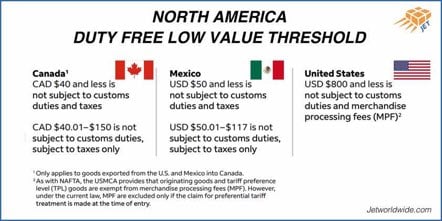
The USA remains the highest-volume corridor, but the rules tightened: the longstanding US duty-free de minimis for low-value parcels has been suspended for commercial shipments, so CUSMA origin documentation is now essential for duty-free entry at any value. Ground courier, LTL, and FTL remain the fastest, most economical modes. Verify the current US tariff treatment for your specific goods before quoting, as the trade policy environment continues to evolve.
Shipping Options from Canada
Select the mode that fits your timeline, cargo type, and shipping volume:
- Canada Post is best for personal shipments and occasional e-commerce.
- Global couriers are best suited for commercial shipments and heavier packages (contact our team for our lowest market rate for shipments over 10 kilograms).
- Air freight via global couriers and 3PLs works great for palletized freight.
- Ocean shipping is best when shipping several pallets and bulk freight.
- International consolidations and zone jumping (contact our team for details) offer the best combination of cost, speed, tracking, and prepaid import duty and fees — especially to the EU and UK.
Note that these are general guidelines. Our team explores all these options and unique routings dedicated to your specific needs.
| Mode | Best Use Case | Typical Transit |
|---|---|---|
| Canada Post | Personal shipments and small packets | 6 to 25 business days |
| Express Courier | Commercial shipments and larger packages | 1 to 5 business days |
| Air Freight | Palletized freight needing speed | 3 to 10 days |
| Sea Freight | Bulk international shipments | 30 to 60 days |
Air versus Ocean Shipping from Canada
Shipments under approximately 200 kg are usually more cost-effective by air. While ocean freight offers a much lower cost per kilogram, it involves minimum surcharges that make it expensive for small loads.
Note: The lowest cost to send a single parcel via ocean is the Canada Post Surface option. It can take a month or two with limited tracking but... hey... it is cheap! And it works well for heavier personal packages.
Free Trade Agreements: Lowering Your Buyer's Landed Cost
Canada has free trade agreements covering over 30 countries, including CUSMA (USA and Mexico), CETA (the European Union), and CPTPP (Japan, Australia, Vietnam, and other Pacific economies). When your goods meet the rules of origin, your buyer can import duty-free — a powerful selling point against competitors shipping from non-FTA countries.
To claim preferential treatment, include a certificate of origin or the required origin statement on your commercial invoice. Note that origin means where the goods were made — not where they were shipped from.
Frequently Asked Questions
What documents are required to export goods from Canada?
At a minimum, international shipments require a waybill and a commercial invoice. Common additional paperwork may include a CERS export declaration and a certificate of origin (for duty-free import via a Canadian free trade agreement).
When is a CERS export declaration required?
A CERS declaration is required for most non-restricted goods valued over $2,000 CAD exported to destinations other than the USA. Restricted or controlled goods may require a declaration and permits at any value.
Can I ship duty-free from Canada to Europe?
Yes, for qualifying goods. Under CETA, products made in Canada enter the European Union duty-free with an origin declaration on the commercial invoice. The buyer still pays import VAT, which varies by member state. The Canada-UK Trade Continuity Agreement provides similar duty-free access to the UK.
Do shipments from Canada to the USA still enter duty-free?
Not automatically. The US duty-free de minimis for low-value commercial parcels has been suspended, so duty-free entry now depends on CUSMA qualification. Goods made in Canada with proper origin documentation can still enter duty-free; non-originating goods may face duties at any value.
What is the difference between air freight and ocean freight?
Air freight is faster and generally more cost-effective for lighter shipments — the break-even typically falls between 100 and 300 kg depending on routing. Ocean freight is better suited for heavier shipments due to the much lower costs per kilogram and being able to spread out the many surcharges over more weight.
How do I find the HS code for my product?
Start with a precise product description, then use the Canadian Customs Tariff or the destination country's tariff lookup to find the matching classification. The first six digits are international; the destination adds further digits. A customs broker can confirm the correct code and the applicable duty rate.
Can my buyer import my goods duty-free?
Possibly. Canada has free trade agreements with over 30 countries, including CUSMA, CETA, and CPTPP. If your goods meet the rules of origin and you provide a certificate of origin or origin statement, your buyer can claim duty-free entry.
How do I get an exporter ID in Canada?
Register for a Business Number (BN) with the Canada Revenue Agency and add an import-export (RM) program account. This number identifies you as the exporter on CERS declarations and other customs documents.

Jet Worldwide Logistics | Global Export Solutions
Contact our experts today for specialized freight rates and compliance assistance.